Friday, 26 March 2010
Engineering
With decisions having been made about my tea strainer and caddy I had to send the two pieces off to be made.

Tea Caddy
With the most of my tea product taking the form of a cylinder it was only natural that my tea caddy take the same form. So my tea caddy will be a little aluminum holder. The innovation about this caddy is that the lid of the caddy will have a bevel in it. This bevel will be the measuring device for how much tea you put in to be brewed. The general rule of thumb is a teaspoon per cup per person. Meaning the bevel will have to be the size of a teaspoon.
Drawings to follow when I go near a scanner.
Tea strainer
 From my sketches I modeled one of my tea strainer designs. A cone to sit inside my cylinder. This came with a few obvious problems, the tea would not have space to brew, it sat awkwardly in the vessel and on the board and while sitting on the board after brewing it would make quite a mess.
 So I looked in to another design from my sketch book. A cylinder to go inside my water vessel. This design would stand on the board and with the holes not reaching the bottom of the filter this should minimize mess.
Drawings to follow when I get a chance to scan my sketch book.
Waiting on glass
With my idea finalised and the drawings sent off to scott glass its now the waiting game for it to return. So with that out the way I can focus on how tea will be brewed, stored and what the tea board will look like.
Friday, 19 March 2010
Simple
After phoning Scott Glass and chatting my idea over it turns out they just cant work to the specifications I require to make my design work. So back to the drawing board.
Why does it have to be so complicated in shape? So I decided its time to go back to basics. Just a straight basic cylinder and to protect users from the heat a double wall will be implemented. Modeled in engineering foam to give me an idea of general shape and size and what is comfy to hold.


Galileo Thermometer
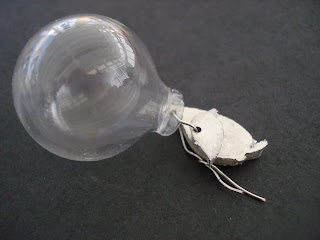
For the critique I did not have a lot of time to think about the weights on the end of Galileo thermometer bulbs so I used washers. With more time to think about what hangs on the end of my bulbs my thoughts were drawn back to adding metaphors to my project and I decided to have leaf shaped weights.
To make these weights I would need to cast them so to begin I cut a variety of leaf sizes out of plastic. Next I obtained a cuttlefish bone (available at any good pet store) and sanded it back to expose a soft inner. My plastic leafs were pushed in to the cuttle fish and a tree was created (the yellow channel). This allowed for the metal to flow to each leaf.
 The red channel is cut wide to create a funnel to make pouring the metal easier. The cuttle fish is then clamped against mdf create a seal around the mould.

The mdf is removed and the mould is revealed.

Finally the leafs were hung on my Galileo bulbs and worked very well.

Wednesday, 17 March 2010
Carafe
Exploration with the glass carafe took through lots of shapes.
 I started with the design of my carafe with hopes of adding metaphors in to my product to give it more meaning. So I started playing with leaf shaped cups. So I knocked up a quick blue foam cup to see how it would feel to hold and drink from. After having several people hold and try the foam cup it went down well. The leaf cup will join on to a cylinder water vessel.
 I used more blue foam to quickly play with how the cup will join together and have the idea clear in my mind before speaking to scott glass to see about having the glass made.
Subscribe to:
Posts (Atom)